
Just finished revisions on a paper. This paper is part of my continued quest to get development economics and development actors re-focused on economic growth, and yes, the more inclusive the better, but “inclusive” is just the adjectival modifier, “growth” is the noun. You might like having a red car more than a blue car but if you don’t have a car its color is hypothetical.
In the paper I address the wild goofiness that many development economists now claim “not by growth alone” (or, even more weirdly that “targeted programs are equally important” as growth to poverty reduction) or that RCTs that horse race types of targeted interventions are the “best investment” for global poverty.
What I do is first construct a non-money metric measure of the “basics” of human material wellbeing using standard indicators from domains like living conditions (access to sanitation), health outcomes (mortality, malnutrition), education (schooling levels), and the natural environment. I then show these new measures of basics have a strong, non-linear relationship with just GDP per capita and that with nothing else the correlation of predicted values and the actual basics is around .9. I also show “yes, growth alone”—that GDPPC is “empirically sufficient” in the sense that no country achieves high GDPPC and does not achieve high levels of the basics (with one exception).
But this is just like an “existence proof”—I can show this for this particular measure. I think do the harder thing and show that essentially every general, plausible, (linear) measure of basics has the same relationship with GDPPC. That is, I engage in the opposite of “data mining” and do “data undermining” where I show that even if I search over all combinations of indicators and weights to construct a general measure of basics to find the measure with the weakest relationship, it is still really strong. I am argue not just that there exists a measure for which this is true but the radically stronger claim that there doesn’t exist a (plausible) measure of basics for which it is not true.
I then use the results to show that “inclusiveness” of growth does matter, but not how it is usually claimed. The usual attention is that growth is too “pro-rich” to benefit “the poor” and hence redistribution is needed. But in poor countries it turns out pretty much no one has “the basics” in the way that a typical middle class person in a rich country has those basics and hence the responsiveness of basics to growth in places like Ethiopia and Pakistan is about the same whether growth is neutral (uniform), pro-poor or pro-rich (within reason).
What does matter is whether growth happens in developing countries. It is the base that growth in Denmark has little impact on basics—because they already are so nearly uniformly achieved. But the elasticity (percent improvement in basics for a given uniform growth rate) is four times bigger in a poor country (Ethiopia, Pakistan or even Brazil) than in Denmark. And even “pro-rich” growth in a poor country has far more impact on basics than uniform growth in a rich country.
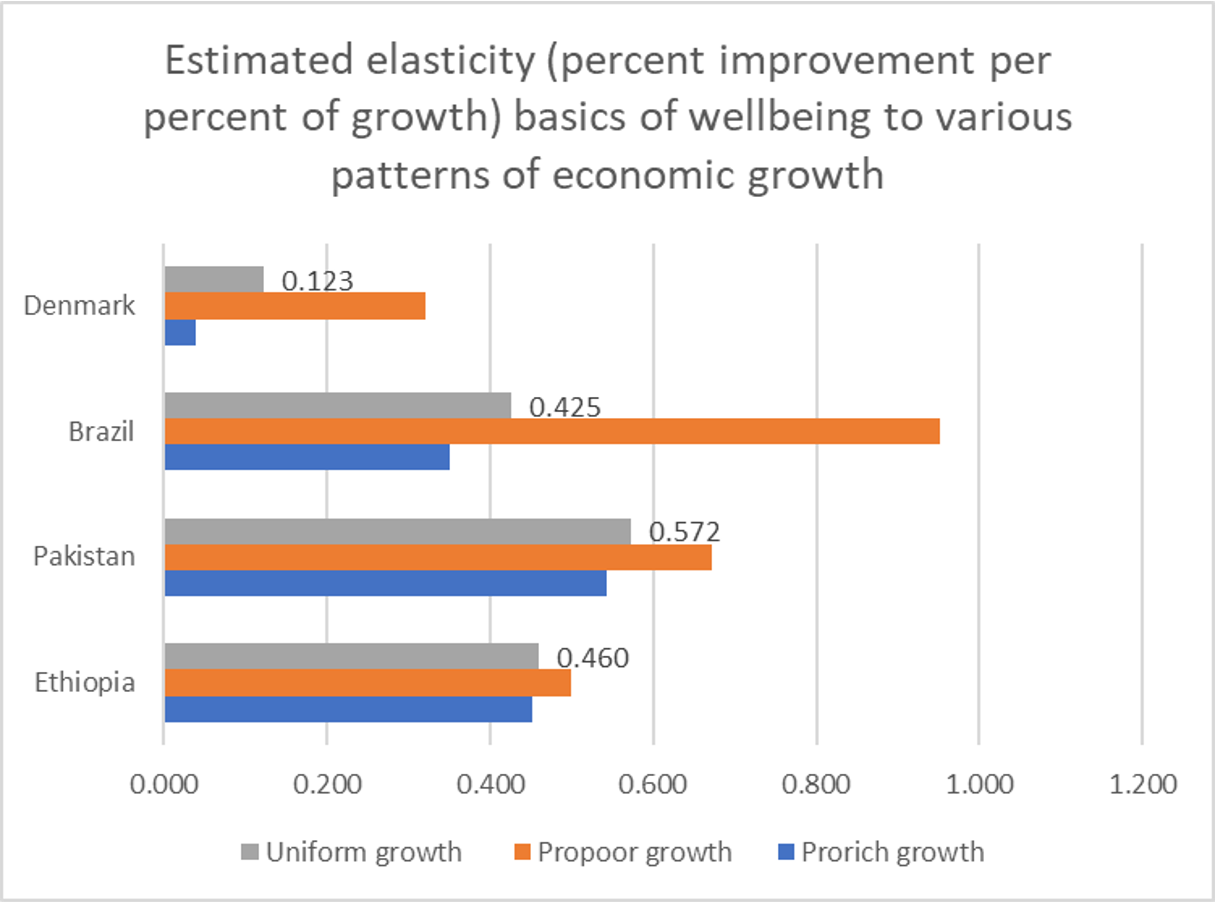
Which raises the question of why so many development economists are so concerned with targeting, redistribution, and that creating the illusion that growth brings benefits if it is “pro-poor” in poor countries, where was is need to rapid, sustained growth? Why are papers by development economists about tiny little gains from targeted programs published in Science (1570 citations since 2015) and Nature (177 citations since 2022) and papers about accelerating economic growth (like this nice paper) get so little attention (22 citations since 2021)?
And what is much more concerning than what development economics does is why do so few “West” based development organizations and actors (bilateral aid agencies, philanthropists, multilaterals) actually want to work on promoting economic growth? Why has charity work displaced development work?
Which are topics for other days. For now just wanted the paper out and about.

I love the paper and the challenge to remember that national economic growth is the ultimate driver of national development. It is noteworthy that the two "basics" with the lowest correlation to GDPPC, primary education and basic health interventions (vaccines etc.) are two areas that have a sustained focus of the global development agenda. Do you think those two facts or correlated?
Do you think the (relatively) low correlations give us cause to say that, yes there is ultimately no development without growth, but the variance in outcomes for countries with similar GDPPC means that we should not pursue an "economic growth and nothing else" approach, but rather a "yes, and..." approach?
Thanks for this insightful work. I’m wondering the extent to which this trend applies in countries that get rich primarily from extractive industries? Particularly with regard to critical minerals, I don’t think they are necessarily major drivers of jobs, but certainly yield large profits overall and thus would positively impact GDP per capita?